Methodology

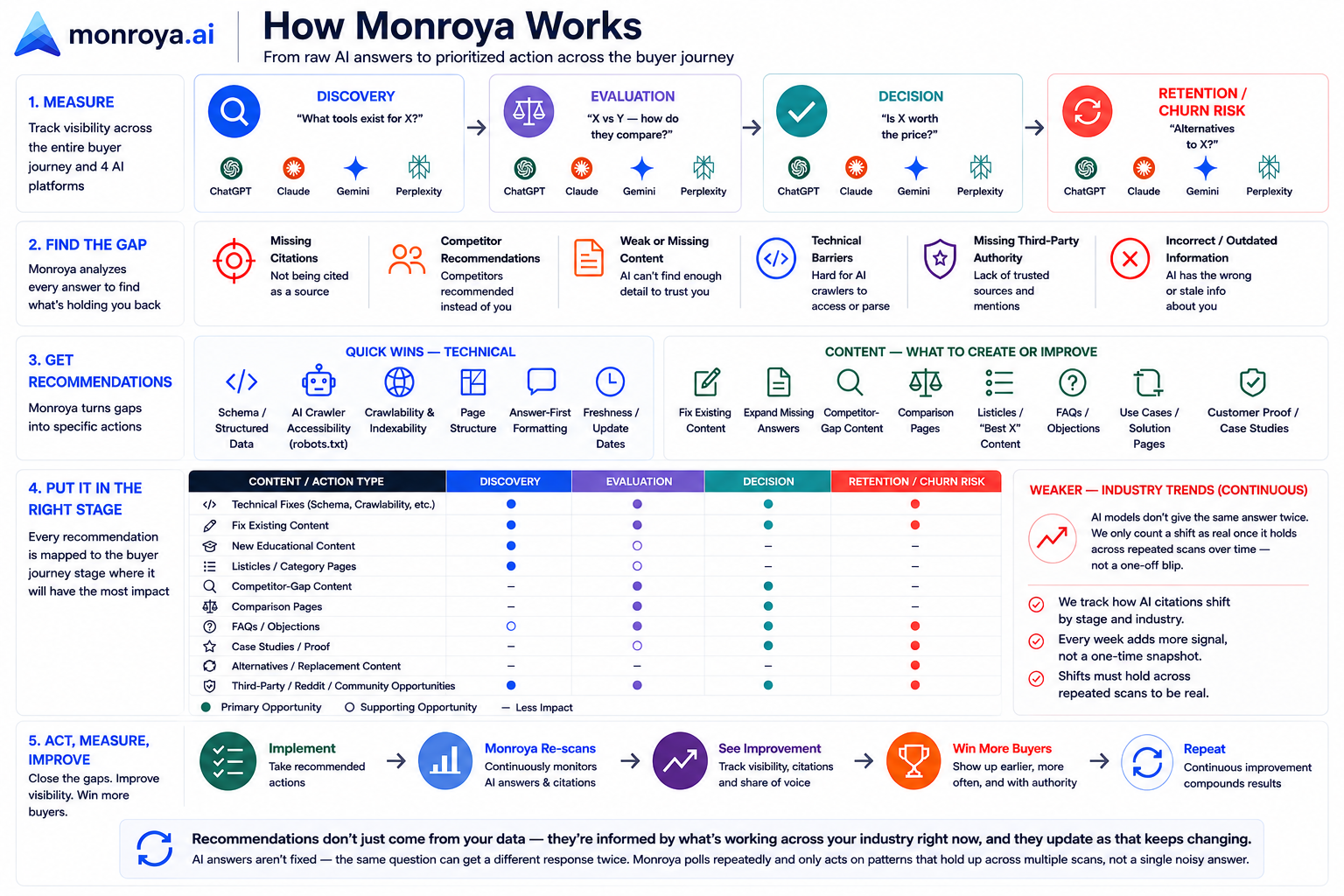
How Monroya works.

The full methodology — from scanning to scoring to the asset draft. No black box.

Updated: July 2026

Multi-run scanning

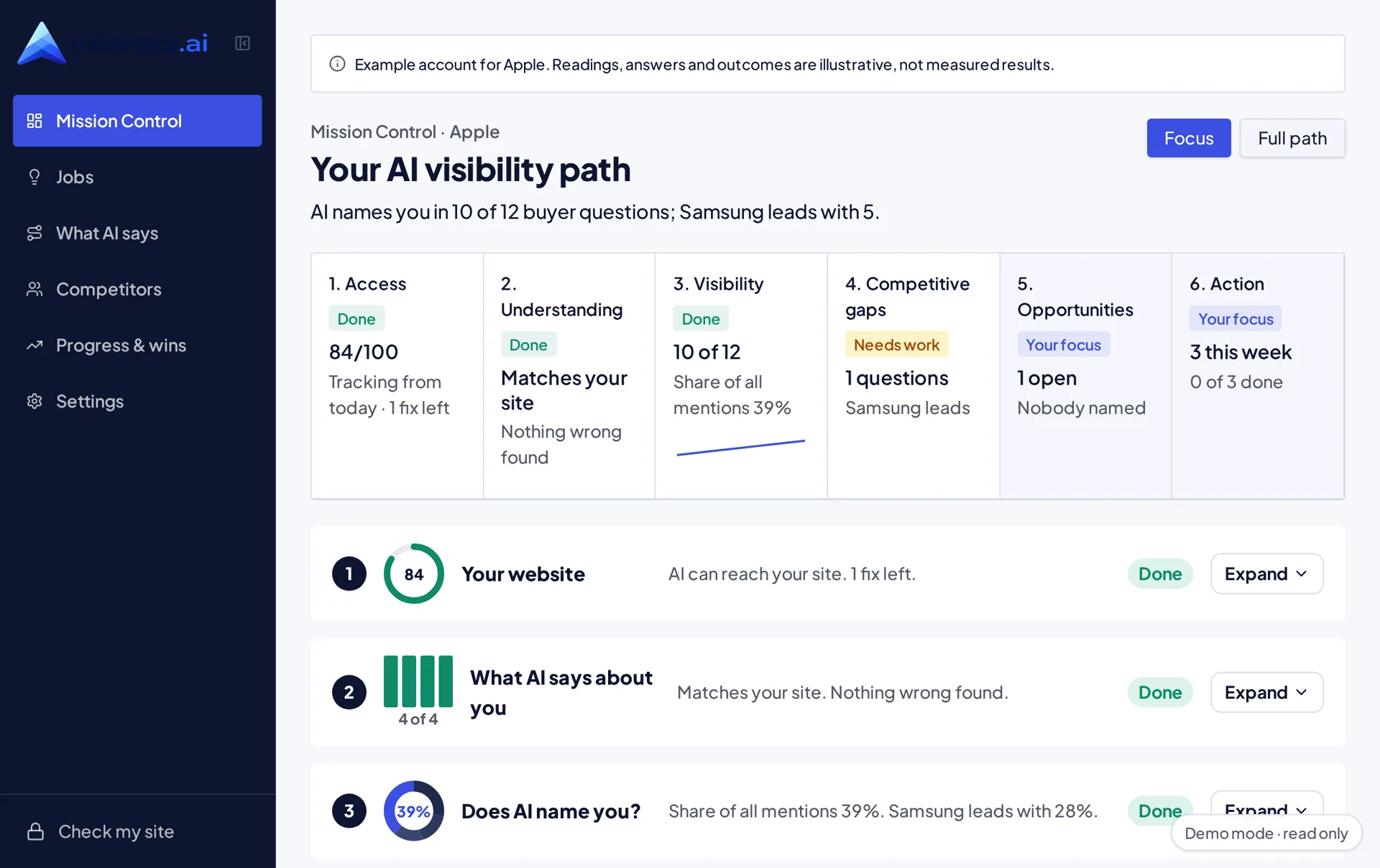
A single prompt to ChatGPT can return different answers minute to minute. To make a score that means something, we run every tracked prompt multiple times per scan and aggregate the runs into a stable signal. Automated scans run weekly; you can also trigger a manual rescan any time. Outliers get smoothed; persistent patterns get surfaced. Your score reflects what AI consistently says, not what it said once.

Monroya executive briefing showing AI Share of Voice, recent wins, and the next best action with priority score.
The platform — Executive BriefingEvery scan rolls up into a briefing: share of voice, what changed since last scan, and the single highest-leverage action to take next.Tap image to zoom

Four providers, not one

Monroya scans ChatGPT (GPT-5 and 4-class), Claude, Gemini, and Perplexity in parallel. Each provider weights sources differently: Perplexity leans on cited domains; ChatGPT favors well-known brands; Gemini pulls from Google's index; Claude tends toward documentation. Looking at all four together is the only way to know whether a gap is universal or model-specific — and the fix differs.

Persona framing

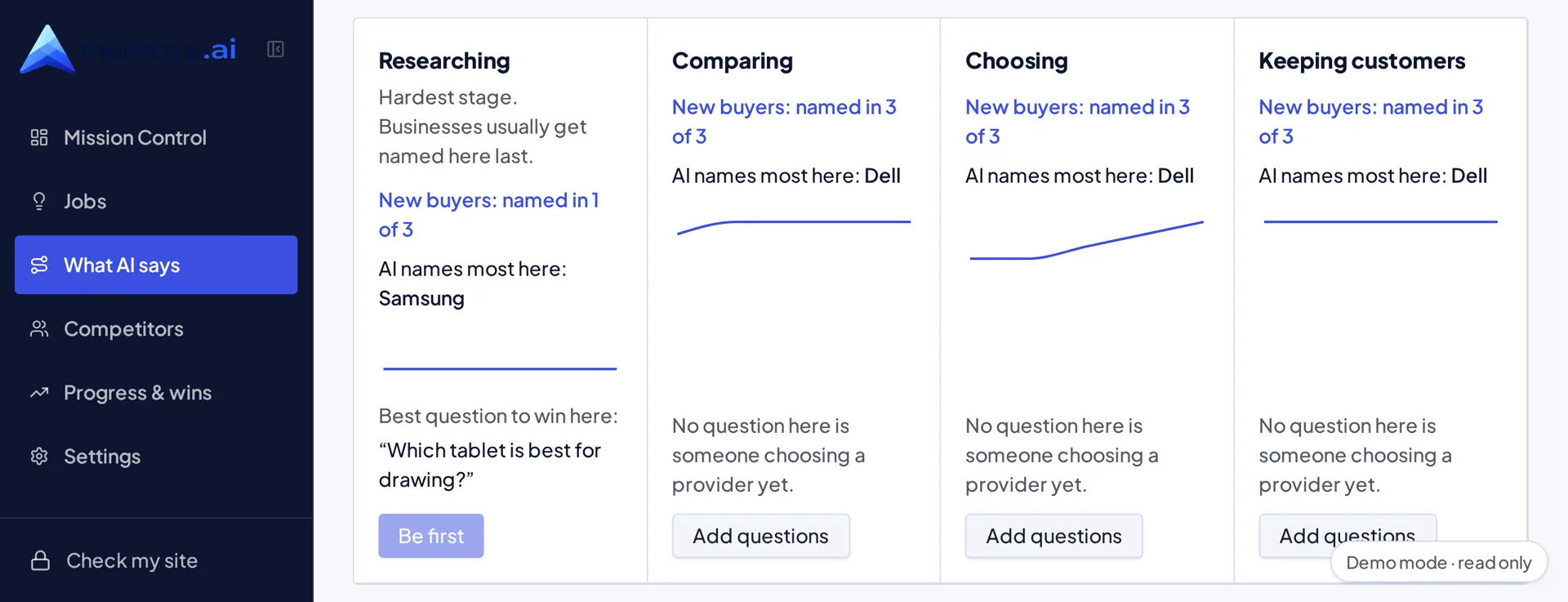
A VP of Engineering asking "best observability tools" gets a different answer than a procurement lead asking the same question. Every prompt in your account is scanned with a buyer persona attached — role, funnel stage, intent. We track your visibility per persona so you see where you're strong with technical evaluators but invisible to economic buyers, or the reverse.

Mention vs citation

A mention is your brand named in the answer text. A citation is your domain linked in the source list. They behave differently: mentions build awareness, citations drive clicks. Most tools collapse them into one number. We track both, because the fix for a mention gap is brand presence on third-party sources, and the fix for a citation gap is your own pages getting indexed and cited.

Buyer Journey matrix showing your company and competitors with mention rates across Discovery, Evaluation, and Decision stages.
The platform — Buyer Journey matrixYou and every tracked competitor, side-by-side across Discovery, Evaluation, and Decision. Amber cells are the gaps a competitor is winning right now.Tap image to zoom

Opportunity scoring

Each gap becomes an opportunity card with three scores:

  • Impact — how much your AI visibility should move if you fix it.
  • Confidence — how often the gap shows up across runs and providers (the more consistent, the more real).
  • Effort — how much work the fix actually takes.

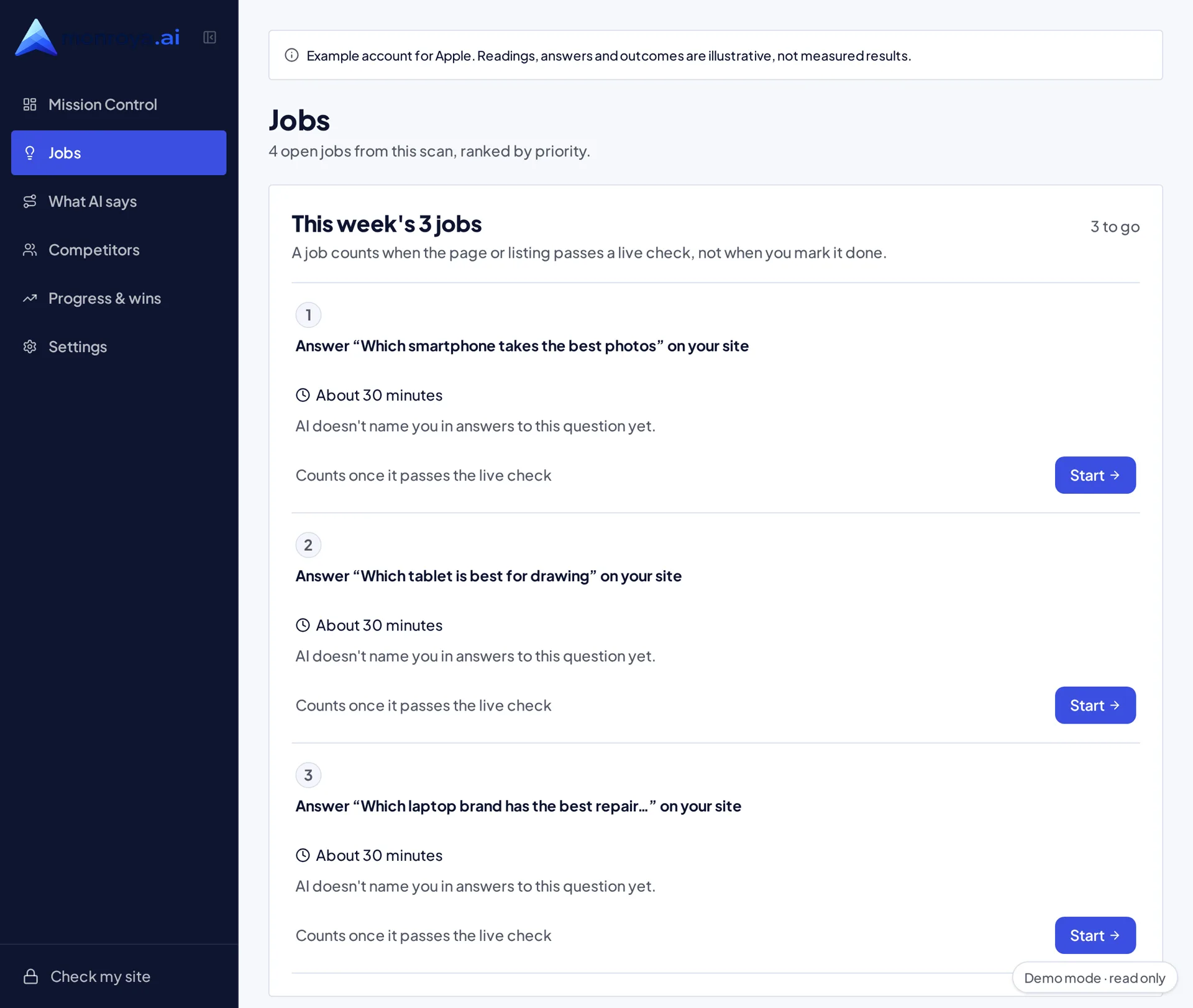
Those three combine into a single Priority score that orders your queue. We show the underlying numbers, not just the ranking.

Opportunities queue grouped by AI Visibility, Content gaps, and Quick wins — each card shows impact, confidence, effort, and a Draft button.
The platform — Opportunities queueEvery gap becomes a card with impact / confidence / effort, the target page, the expected timeline, and a Draft button that writes the asset.Tap image to zoom

Draft generation

When an opportunity needs a new asset — a comparison page, a pitch to a publication, a Reddit answer, a fact sheet — clicking Execute drafts it. The draft uses the gap evidence as input and writes in your buyer's voice, not generic marketing copy. Every draft is fact-screened: invented stats, fabricated version numbers, and made-up customer counts are flagged before you ship. Stats-heavy formats retrieve fresh, dated sources at draft time so the numbers you cite are current. You edit and ship. No copywriter handoff, no two-week loop.

Prompt improvement engine

Tracked prompts don't sit static. When a prompt's citation rate drops or stalls, Monroya generates richer variants — different framings, persona angles, comparative phrasings — and runs them alongside the original. The variant that earns the citation gets promoted into your active set. You see the variant history and can accept, reject, or pin any version.

Per-page GEO quick-wins

The site crawl doesn't just feed prompt generation. Every indexed page is graded for GEO readiness — schema coverage, citation-ready structure, freshness, internal-link depth — and surfaces a short list of one-edit quick-wins per page. The kind of fix that takes 15 minutes and shifts a citation rate the next scan.

Playbook learning

When you mark an opportunity complete, we capture a baseline of your stage-inclusion rate. After the expected timeline passes and your next scan runs, we measure the delta. Once a given (action type, asset format, journey stage) combo has 3+ measured outcomes, its aggregate success rate re-weights future priority scores — confirmed winners get a +20% boost, consistent failures get a -15% penalty. Your verified playbook is auditable on the Progress page.

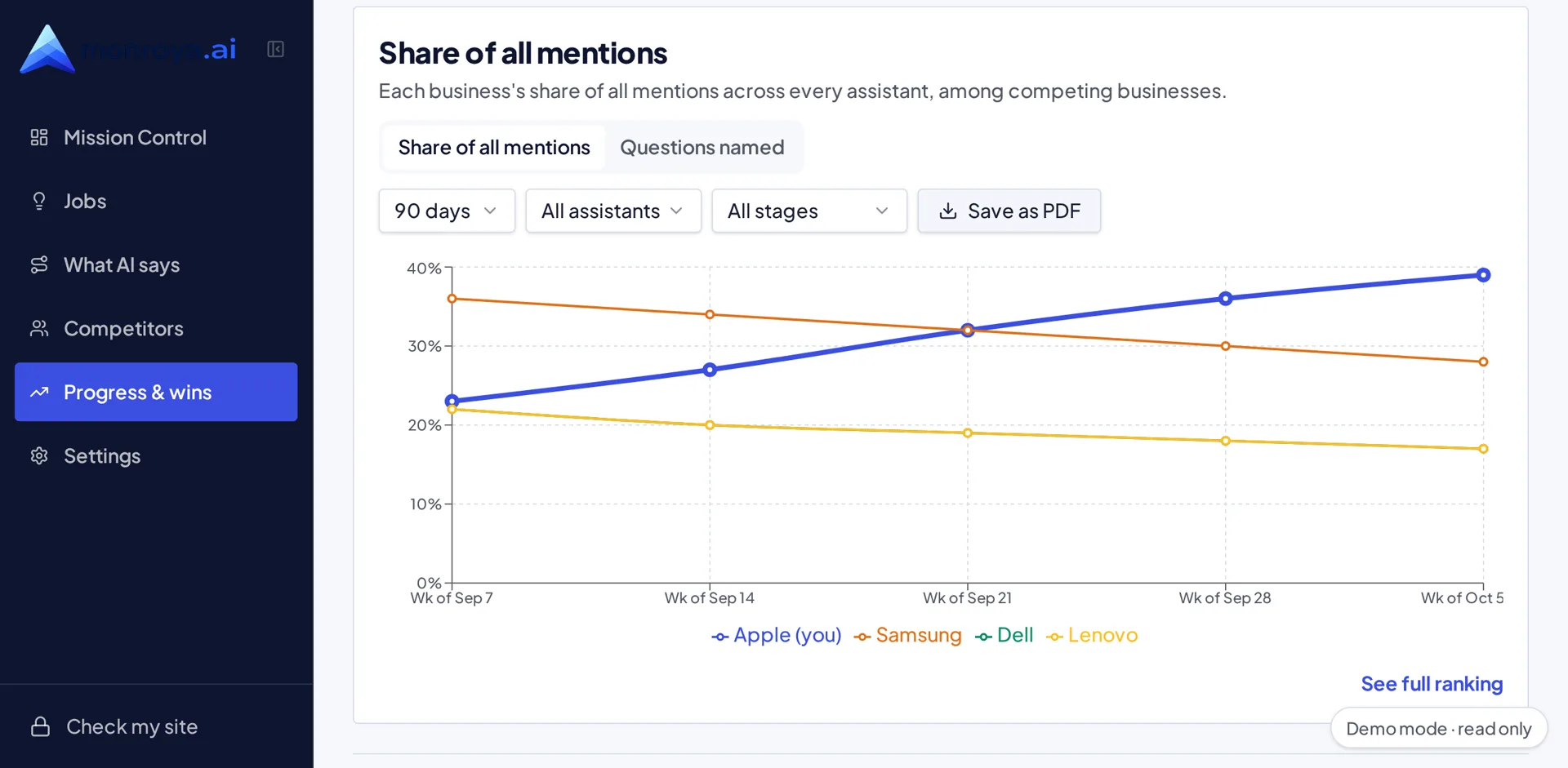
Progress page showing AI mention rate, discovery/evaluation/decision inclusion sparklines, citation unlock progress, and share-of-voice trend over time.
The platform — ProgressRolling averages, stage-level sparklines, and an actions-vs-visibility chart. Every completed action is matched against its follow-up scan so you see what actually moved the number.Tap image to zoom

Auditable by design

Every score traces back to the raw model responses that produced it. If your AI Share of Voice dropped three points, you can see which prompts moved, which providers shifted, and what the actual answer text was. Nothing about the methodology is hidden behind a black-box score.

Frequently asked questions

How many times do you run each prompt?
Every tracked prompt runs multiple times per scan across each provider. We aggregate the runs into a stable signal so a single bad sample doesn't flip your score. Automated scans run weekly (with on-demand manual scans any time) so you're tracking trends, not one-shot snapshots.
Why four providers instead of one?
Buyers don't use one model. ChatGPT, Claude, Gemini, and Perplexity each weight different sources, surface different competitors, and answer with different confidence. Tracking one provider gives you a partial truth.
What's the difference between a mention and a citation?
A mention is your brand named in the answer text. A citation is your domain linked in the source list. Both matter, but citations move buyers further down the funnel. We separate them so you know which gap to close.
How do you frame personas?
Each prompt is scanned with a buyer persona attached — role, stage, intent. The same question from a VP of Engineering and a procurement lead returns different answers, and we track both separately so your scoring matches your actual ICP.
How is opportunity score calculated?
Each opportunity gets three sub-scores: impact (how much it would move your visibility), confidence (how consistently the gap appears across runs and providers), and effort (how hard it is to ship). Priority is the combined score.
What does draft generation actually produce?
A complete first draft of the asset the opportunity calls for — a page outline, a pitch email, a community post, or a fact sheet. Written in your buyer's voice using the gap evidence as input. You edit and ship.
Do you store the raw model responses?
Yes. Every run is stored so any score can be audited back to the source. If you want to see the actual ChatGPT answer that drove a finding, it's one click away.
What's playbook learning?
When you complete an opportunity, we capture a baseline. After your next scan past the expected timeline, we measure whether your stage-inclusion rate moved. With 3+ measured outcomes in the same (action type, format, journey stage) combo, future opportunity priority scores get re-weighted: confirmed-winning combos get a +20% boost, consistently-failing combos get a -15% penalty. Your verified playbook is visible on the Progress page.

Related reading